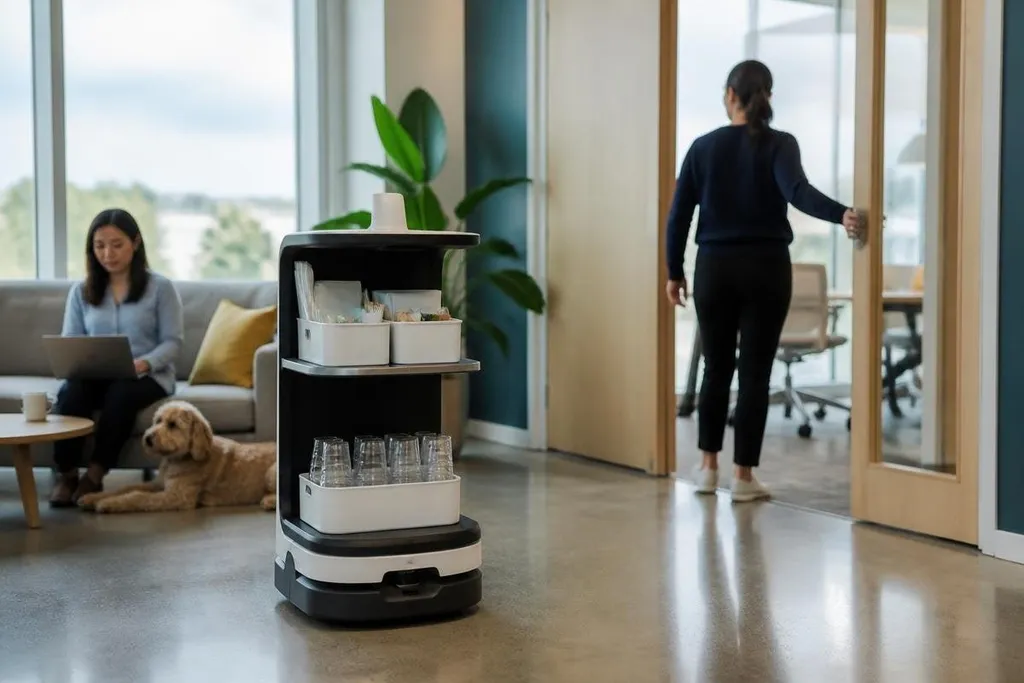
A service robot works around people, furniture, doors, pets, and changing plans. The next wave will earn its place through small tasks done safely and often, not through a larger list of features.
For a buyer, the question is practical. Can this robot finish a job with less staff time, fewer errors, or less physical strain?
- Job first: start with one repeated task and define success in numbers.
- Safety matters: check how the robot stops, what it detects, and who can intervene.
- Proof beats demos: ask for results from the same type of site you run.
The work comes first
These systems work in places built for people. A hotel has narrow corridors and lifts. A hospital has moving beds and privacy rules. A shop changes its layout when stock arrives. Each setting gives the robot a different problem to solve.
That makes a clear task more useful than a broad promise. Carrying linen between two fixed points is easier to measure than “helping staff.” A robot that guides visitors needs a different test from one that moves food trays.
Start with the task, then set the measure. You might track completed trips per shift, missed deliveries, human interventions, or time spent charging. The measure should match the cost you want to control.
The parts that need to work together
A service robot usually combines cameras, LiDAR, motors, software, and a battery. LiDAR measures distance with light pulses, helping the robot build a map and avoid objects.
The parts have to work together during a real shift. Navigation is one test. Recovery is another. A person may leave a cart in the robot’s route, or a door may stay closed. The robot needs a safe way to stop, ask for help, or choose another route without blocking the space.
The handoff matters too. A delivery robot may reach the right room and still fail if a worker cannot open its compartment quickly. A cleaning robot may cover the floor and still lose value if staff must move chairs before every run.
The handoff gives buyers a clear test for the claims they read on Robot24.com. Look for the robot model, task, site, and result, then ask whether staff time went up or down. Those are the details worth asking vendors to show.
What buyers should ask for
Marketing material often lists sensors and software names. Ask for operating results instead. A useful report should tell you the robot’s payload in kg, runtime in hours, charging method, speed, turning space, and IP rating where water or dust is present.
Those figures need a setting. A payload number has little value if the robot can carry a box only on a smooth floor. Runtime also needs context because lifts, ramps, stops, and remote help all change battery use.
Safety details deserve the same care. Ask where the emergency stop sits, how the robot detects a person, what happens after a sensor fault, and how quickly a remote operator can take control. A safe system has a clear failure response, not a vague promise that the robot will “understand” its surroundings.
The open limits
The setting shapes the work. A site with fixed routes, known doors, and trained staff gives a robot an easier job than a crowded public area with constant changes.
Software updates may improve a robot’s behavior, but they don’t remove physical limits. A small wheel may struggle with a threshold. A short battery may force a charge stop during the busiest part of a shift. A narrow arm may reach the shelf but fail to place an object securely.
The strongest opposing view is that better software will solve many of these problems. It may reduce some failures, but the building, task, and robot hardware still set limits.
I'd judge a service robot by the work it completes after the demo ends. A polished video proves that a task happened once; a buyer needs records from repeated shifts.
A purchase check before signing
Use this list when comparing a robot with manual work or another system:
- Name one task: write the start point, end point, object, and handoff.
- Set the measure: choose trips per shift, minutes saved, error rate, or interventions.
- Check the site: record doors, lifts, floor changes, people flow, and network coverage.
- Ask for logs: request completed tasks, stops, faults, charge time, and remote calls.
- Price the whole system: include installation, training, software fees, repairs, and staff time.
- Set a trial limit: decide the result and date that would stop the rollout.
That last point protects the purchase from a good first week. A service robot needs to show repeatable work in the place where it will run, with the staff who will depend on it.
The next useful step is a narrow pilot with a written target: one task, one site, and a result you can check after 30 days.